
Where the Window Begins
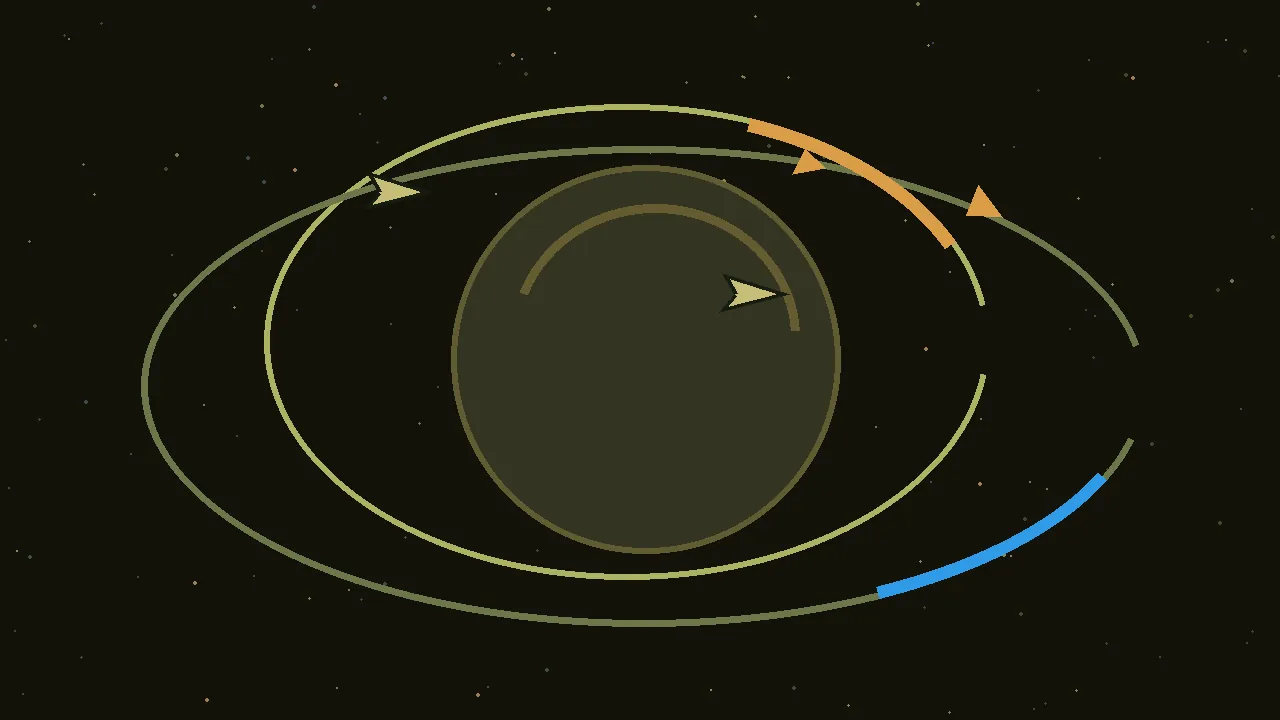
Give the start of a window a place on the map
The station in the early orbital study has an amber section beside its outer ring. A fleet can reach that section before the next turn. We first drew a single point at the middle of the window. When a second fleet appeared, a player could tell where both wanted to go but not when they could still use the same passage. We added two ends to the amber section and put an arrow beside the earlier direction. The opening now has a clear place it begins and a point where another fleet can still wait. The amount of time shown belongs to the tabletop game. Put a short label by the stop rather than setting it above both curves where it could describe either one.
Let the route keep its earlier edge as a fleet arrives
At the first frame the near fleet can choose one of two curves. A path at the other height gives it a later chance to travel. The window itself stays near the same station. Show which part of the map could be reached before that choice. In an earlier drawing, the whole ring changed hue whenever a route took a crossing. We kept the older curve dark and used a pale border for the opening portion that still matters. This can be read after the movement stops. A reader has at least one useful location to compare with a later frame. If they follow the other fleet first, the past window should remain visible where they start.
Draw the later arrival before comparing two choices
In The Window at Amber Ring, give the late group one visible departure with a part of its old curve nearby. The first group can cross or take the longer approach. Both states leave the same later request on the map. We want a player to describe whether it can arrive and still use the opening. If a result changes both the current path and the time the late group appeared, restore the same arrival before testing it again. Keep the nearby station readable so somebody can follow the choice without seeing the prior route move. The diagram should be consistent for someone who looks at only the two stills.
Put the end mark where it answers another question
The start of the window tells a player when a transit can happen. The end tells them when another movement has to wait. Show both alongside a route that uses the next model turn. The current example keeps one possible waiting place under the station instead of drawing it as a second bright opening. An Open Place to Wait considers how that place can remain open while another fleet still crosses. The latest result should show which curve it can enter from. Ask a reader to locate its earlier mark and see whether they can explain why another turn was needed. The two edges have separate roles when they support that reading.
Check the same edge from either side
Give a tester the newer map and ask where the first opening began. Open the older map and ask which part of the loop made another approach possible. A short answer can mention the station and a mark at one end. If the player reads an arrow as the time boundary, put a little space between the arrow and its start marker. The next view can compare a shorter window with the same direction before moving to another station. That gives us a way to study a new time without making the old path unrecognizable. Retain the first result after the test so a reader can see which group still had somewhere to wait.