
Read the Loop from the Far Side
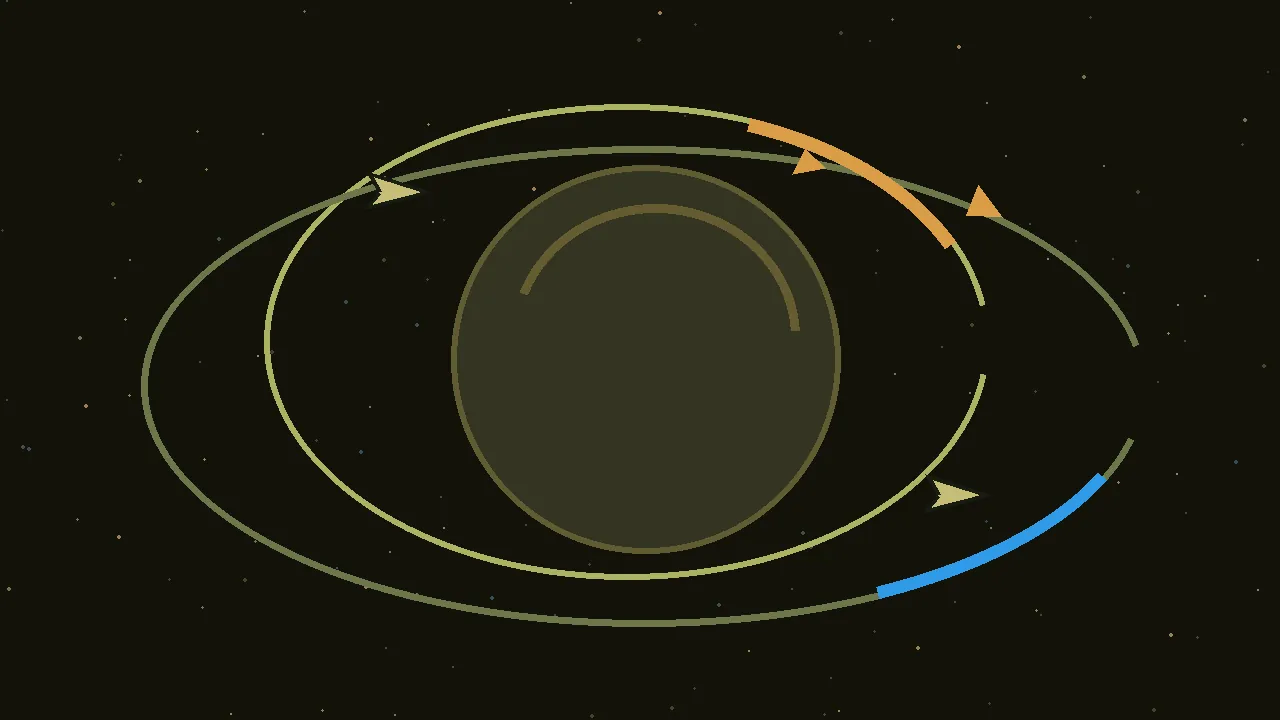
Open at a familiar destination rather than the departure
One still of the model begins at the station that can receive a group. Two curves approach it. The fleet might reach it after opening a nearer window, and a different group can get a later chance. We printed one destination beside a broken line for its earlier state. A tester could find the station but had to trace farther than expected to find where the group began. We moved the first arrow closer to the recognizable start marker instead of adding another legend. That gave the map a place that can be read from either direction. The next frame should preserve the same station while the player looks back along the second curve.
Keep direction and availability from sharing an arrow
The early chart used the same blue arrow for movement and the point where a fleet could still cross. A reader starting at the destination saw a trail to the correct place but thought it was usable before the current opening. We left a small directional wedge near the curve and gave the crossing a flat part beside its time label. The player can find both without reading them as the same kind of fact. On a small screen, put a caption below the arc rather than moving the arrow to an unrelated path. The still retains a clear station and an earlier turn mark. Give somebody a place to point to before asking them to describe the direction of the first movement.
Read the later question before tracing the old line
Try The Window at Amber Ring from the later frame. See which group could still reach the station, then find the earlier window that mattered. Keep the previous route and the unchosen curve visible. A reverse reading helps the player ask which earlier position can be changed. It can also show why the newer route never crossed the first opening. Use the time label and the earlier arrow to find that point together. Both can be present in a small diagram even if the later group takes up more of the picture. We can check whether somebody can tell which direction they are following while preserving an earlier turn.
Give the wait its own distant landmark
A fleet can have reached a recognizable position while needing another turn. Put the holding mark far enough from the station that a reader can identify why the most recent flight stopped there. In Hold at the Blue Mooring, there is a separate opening for the next curve. A person starting at the mooring can trace the earlier line back to its approach before deciding whether to wait. The map retains one bright corner for that reading. If both scenarios show a route crossing in the same place, move the earlier stop into its own panel and see whether a reader can still see which one applies now.
Compare two explanations of the same passage
Ask a tester to trace one route from its start, then start at the station in the other trial. If both reach the same earlier turn marker, keep that landmark and check a second fleet. If the reverse reading produces a different answer about reachability, make the window boundary stronger before adding another arrow. The next draft can preserve the station and let one directional cue move. Try reading the result with the motion paused. The first answer should identify a point on the curve and give a reason why another one was still open when the known fleet arrived.
The next reader can then choose to approach that same place from a different circle.